



















































































































Melahel occupies the twenty-third position in the series of the seventy-two names of Western Kabbalistic angelology. In La Science cabalistique, published by Lenain in 1823, he is associated with plants, water, the produce of the earth, aid against dangers, and the protection of travelers. This portrait provides access to a particularly concrete branch of the tradition of the genii: one that connects the plant world, ancient healing knowledge, and confidence in the face of the risks of travel. To understand this figure, one must read the historical entry and place it within the religious and naturalist world of its era.
| Name | Melahel, sometimes transcribed as Mélahel |
|---|---|
| Position | 23rd name in the seventy-two-name system |
| Major source | Lenain, La Science cabalistique, 1823, pp. 59–60 |
| Assigned choir | Thrones, in the distribution by groups of eight |
| Lenain's correspondence | 111th to 115th degrees of the sphere |
| Themes | Plants, water, travel, and protection in times of danger |
The Twenty-Third Name in a Kabbalistic Series
Melahel belongs to the seventy-two names linked to a combinatorial reading of three verses from Exodus, chapter 14. The Hebrew text provides three series of seventy-two letters, which Kabbalistic traditions arrange in columns according to an alternating reading pattern. The names of the genii then emerge from these combinations, particularly when Renaissance authors incorporate them into systems of angelology.
The tradition of Johann Reuchlin and the works that extended his teaching helped give these groups of letters the form of individual names. Later occult treatises associated each one with a place in the sphere, one or more psalms, and particular qualities. This context explains why the function attributed to Melahel varies according to the authors and calendars.
In the series reproduced by Lenain, Melahel occupies the twenty-third position. His name therefore falls within the third group of eight, linked to the choir of the Thrones in this classification. This position belongs specifically to the structure of the treatise.
Melahel's Entry in La Science cabalistique
In 1823, Lazare Lenain published a work bringing together the seventy-two genii and their attributes under the title La Science cabalistique, ou l'art de connaître les bons génies. Melahel's entry appears on pages 59 and 60. His attribute is rendered by the phrase “God who delivers from evils,” expressing a general relationship with protection and aid.
The author assigns this genius degrees 111 to 115 of the sphere and the twelfth decan, which he places under the influence of the Moon. These elements illustrate the mixture of astrological data, divine names, and religious references characteristic of the treatise. They do not constitute a liturgical calendar of the Catholic tradition.
Reading the entry in its original context also shows that Lenain does not classify the names solely according to moral virtues. He assigns them areas of nature, protective functions, and relationships with professions or human activities. Melahel provides a particularly clear example of this.
Medicinal Plants and the Produce of the Earth
An important part of the text concerns the plant world. Lenain presents Melahel as a genius exercising influence over plants useful for healing, as well as over the produce of the earth. In this conception, the natural world possesses an order that can be read through the qualities of plants, water, and celestial influences.
This vision refers to a long history of traditional botany, herbals, and planetary correspondences. Western authors sought to connect the properties of plants with the spheres of heaven and spiritual names. Melahel's entry belongs to this intellectual heritage, in which the classification of genii provides a framework for interpreting nature.
However, it would be inaccurate to conclude from this that the angel guarantees therapeutic effects. Plants have properties that today require botanical identification and an assessment appropriate to their uses. The history of plant correspondences can be studied in its own right without replacing contemporary medical knowledge.
Water, Travel, and the Protection of People
Lenain also attributes to Melahel a connection with water and travel. The text refers to protection from weapons and the possibility of traveling safely. This dimension brings the genius closer to the practical concerns of a world in which travel remained exposed to accidents, attacks, and the uncertainties of the roads.
The image of the protected traveler belongs to several Christian traditions and numerous collections of prayers. In Lenain, it is inserted into a system combining angelic names and cosmic influences. It is therefore not the same framework as the account of Raphael accompanying the young Tobias, even though the two figures have been associated with the safety of travel.
This contrast shows how the same human need can receive different religious representations. The Book of Tobit tells a continuous story; Lenain's catalogue assigns domains to names brought together in an angelic series.
The Psalm of Departure and Return
Melahel's entry cites the final verse of Psalm 120 in French liturgical numbering, corresponding to Psalm 121 in other Bibles. The text states that the Lord watches over a person in their departures and returns. This passage directly corresponds to the theme of protection during travel.
The borrowing is interesting because it connects a scriptural phrase with one of the attributes of a genius. Lenain takes a familiar prayer text and places it within a structure of correspondences that includes hours and degrees of the sphere. The religious significance of the psalm should not be confused with the historical validity of all the associations developed by the author.
The verse has its own meaning in the liturgy and in the Christian reading of the Psalms: it affirms trust in God's protection. Lenain's angelology constitutes an additional interpretation of this prayer tradition.
The Thrones and the Eight Names of the Third Group
Melahel belongs to the group of names 17 to 24 in the classification of the seventy-two genii by series of eight. This group is associated with the choir of the Thrones, also known in the Christian hierarchy of the nine angelic choirs. The two sets nevertheless have distinct histories.
The theology of the Thrones, developed notably by Pseudo-Dionysius the Areopagite, concerns the place of the celestial orders within a hierarchy of contemplation and service. It does not provide the twenty-third, twenty-fourth, or twenty-fifth names of Lenain's treatise. Christian Kabbalah adopted these categories and linked them to its own angelic distribution.
Studying the choir of the Thrones makes it possible to trace this theological history. Melahel's name then bears witness to the work carried out by occult authors to construct additional correspondences.
The Transmission of the Name in Contemporary Compendiums
Modern books devoted to the seventy-two angels have preserved Melahel's association with vegetation, travel, and aid in difficult situations. They also assign him specific days and colors, whose indications may vary from one system to another. Modern calendars do not always reproduce the same dates as Lenain's tables from 1823.
The Catholic Directory on Popular Piety discourages assigning personal names to angels other than Michael, Gabriel, and Raphael. Melahel's place in a historical compendium therefore belongs to the heritage of occult angelology and the Christian reception of Kabbalistic materials.
His interest lies in the meeting of three worlds: the Hebrew combinations derived from Exodus, the learned classifications of the Renaissance, and the naturalist concerns of a French author from the 19th century. Reading the original entry makes it possible to preserve these dimensions without reducing Melahel to a single quality.
Sources and References
Lenain, La Science cabalistique, Amiens, 1823, entry no. 23, pages 59–60, transcription of the original edition.
Bibliothèque nationale de France, bibliographic record for La Science cabalistique.
Psalm 120, verse 8, prayer for protection at departure and return, AELF.
Exodus, chapter 14, verses 19–21, the text underlying the construction of the seventy-two names.
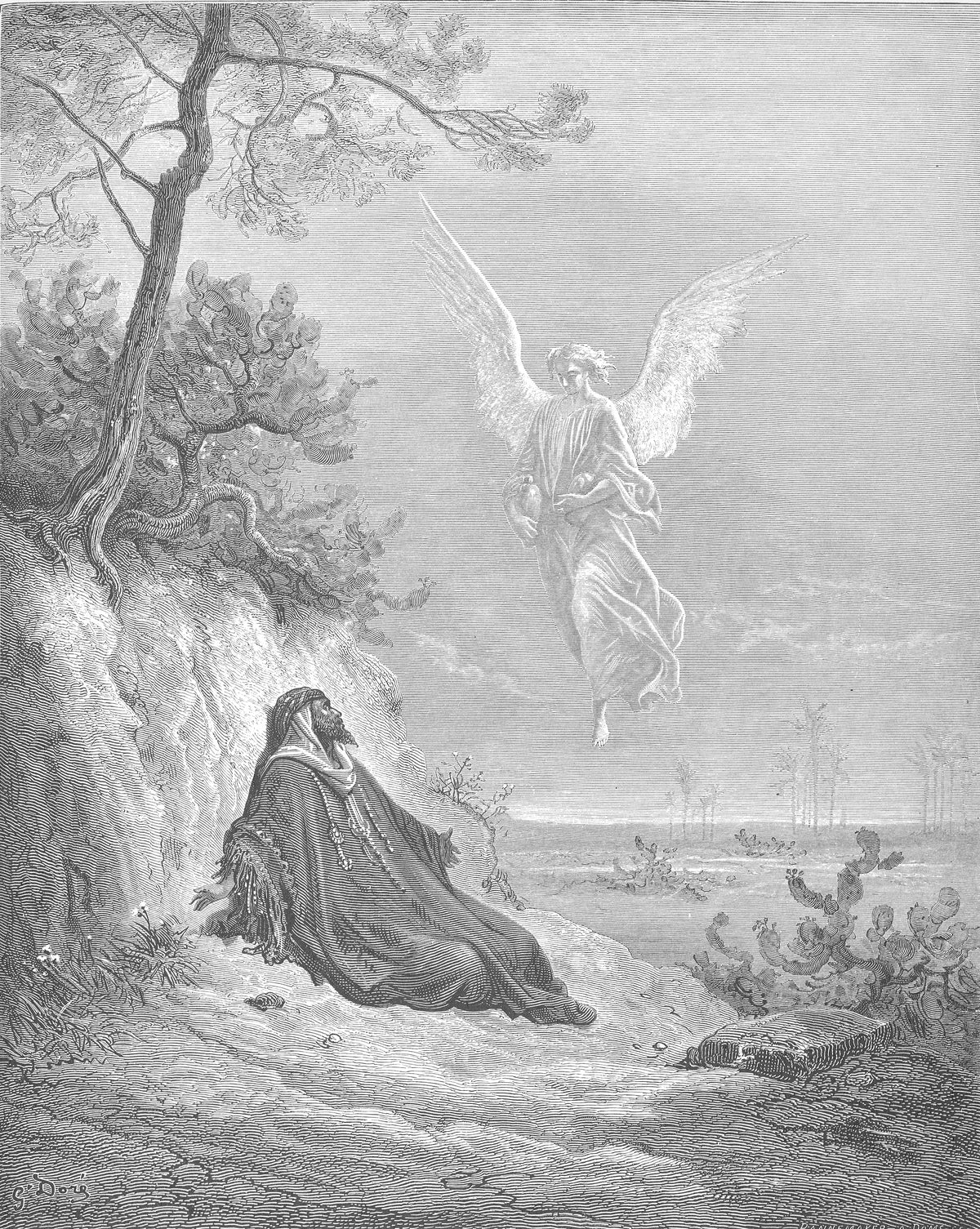
Illustration: Gustave Doré, Elijah Nourished by an Angel, 1866, historical public-domain work. Symbolic image of the theme of angels, not an ancient portrait of the figure named in this article.










