

















































































































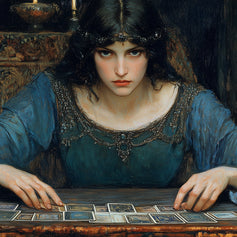

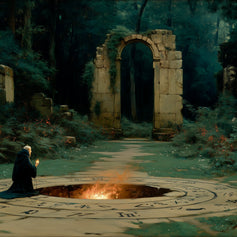
At first glance, a knucklebone looks no different from a toy found in the dust. A child throws it, a player waits for it to come to rest, an adult looks at the face that appears. Yet this little sheep or goat bone held a remarkable place in the Greek and Roman worlds. It is found in homes, tombs, and ancient images. In some cities of Asia Minor, its movement was even interpreted as a response from the gods. The chance fall of an almost insignificant object could then enter the solemn language of an oracle. It is this passage from play to divine utterance that makes the history of knucklebones so fascinating.
The Greeks called these pieces astragaloi, the Romans tali. The terms refer to a specific physical object, the astragalus from the hind leg of certain animals, before also referring to its recreational or divinatory uses. We should avoid telling a story in which every knucklebone found is a talisman. Evidence of religious activity requires more than a bone being found. Inscriptions, literary sources, and archaeological finds make it possible to distinguish what belongs to a game, an offering, or a genuine consultation of fate.
Astragalomancy is divination that associates the fall of these small bones with predetermined answers or interpretations in a religious context. It was neither a general pastime for all worshippers nor a uniform method practiced over several centuries. The most precise information comes in particular from Pisidia and neighboring regions of Anatolia during the Roman period. It reveals a world in which chance does not necessarily oppose the sacred: it can become the event through which a human question receives an answer attributed to a higher power.
The four faces of an object inherited from the animal world
The astragalus belongs to the hind-leg joint of sheep, goats, and other animals. Once separated from the leg, it makes a compact, hard object that is easy to grasp and regular enough to be thrown. Its anatomical structure is not cube-shaped. It has four faces on which the bone can generally come to rest, with different contours and dimensions. This detail explains how astragalus games and divination worked. The throw has its own logic: each face does not necessarily appear with equal frequency. The ancients were not entirely unaware of this irregularity, since they handled and reproduced such objects in various materials.
The Metropolitan Museum of Art in New York holds a bronze astragalus dated between the 3rd century BCE and the 2nd century CE. The institution notes that natural examples came from domestic animals and were used in dice games as well as games of skill. It also has Hellenistic glass pieces, including a cobalt-blue example. These objects show that the astragalus had become a familiar form, one that artisans could reproduce regardless of its animal origin. An imitation in bronze or glass does not by itself prove a religious purpose, but it reveals the recognized place of this shape in ancient material culture.
The values assigned to the sides of an astragalus are generally given as 1, 3, 4, and 6. The sequence does not follow that of an ordinary die, and the pieces do not necessarily bear visible numbers. It is the convention adopted by players or consultants that links the bone’s position to a numerical value. For an archaeologist, this difference complicates the interpretation of an isolated artifact. A small unmarked bone may come from a meal, a game, an intentional deposit, or displaced furnishings. Only the context makes it possible to decide whether it is evidence of a social or spiritual practice.
Knucklebones have been found in dwellings, graves, and near sanctuaries. Their presence beside the dead may evoke the pastimes of childhood, accompany the deceased as a familiar object, or serve a function that is now difficult to determine. The New York museum notes this funerary dimension without equating every piece with a prophetic instrument. This restraint is essential. The same bone may have been played with for years and then buried; its final destination alone does not reveal all its earlier uses. When it comes to divination, the material alone is never enough: one must look for an attested link between the way the bone falls and a system of answers.
Groups of Greek figurines depict women crouching around knucklebones. A remarkable terracotta group held at the British Museum, dated to around 330–300 BCE, attests to the place of play in representations of the Hellenistic period. Artists were interested in bent bodies, hands reaching forward, and the suspended moment before the outcome. One might be tempted to read it as an oracular scene, but there is no evidence to support that interpretation. The subject depicted belongs to the world of leisure and social life. Art history helps us recognize the gesture here, while inscriptions from other regions help document its possible religious meaning.
Knucklebones remind us that objects imbued with spiritual significance need not be made of rare materials. A natural form could be transformed into a cultural tool through repeated gestures and knowledge of the possible outcomes. The irregular surfaces of the astragalus make visible the limits of any human effort to control exactly how it falls. This element of uncertainty lent itself to play as well as divination. We can therefore understand how an object from the animal world could move from everyday life into a religious sphere, provided its setting, purpose, and interpretive framework changed.
The pleasures of play and the first images of fate
In the first book of his Histories, Herodotus recounts a Lydian legend that links the invention of several games to a period of famine. The inhabitants are said to have alternated days of eating with days of entertainment to endure the shortage. This story belongs to the realm of legendary origins; it does not actually date the invention of knucklebones. Nevertheless, it shows the place these objects held in the imagination of ancient authors. Playing could be more than a pastime: it was a way to pass the time, share a collective hardship, and give rhythm to daily life.
The rules were not limited to the outcome of a face landing upward. In some games of skill, pieces were tossed and then caught on the back of the hand. Elsewhere, they were used to count points or compare combinations. Ancient images show children, but also women and adults absorbed in play. Our reconstructions remain partial, since rules varied and the texts did not describe every gesture. It would therefore be misleading to speak of “knucklebone games” as a perfectly uniform activity. The object brought together several activities that involved manipulating small pieces and awaiting an outcome.
The National Archaeological Museum of Naples owns a marble painting found at Herculaneum in 1746 and signed by Alexandros of Athens. Two young figures are playing knucklebones, while the composition evokes the mythological story of Niobe and Leto. The Institute for the Study of the Ancient World dates it to between the 1st century BCE and the 1st century CE. Greek inscriptions identify the figures. This painting is particularly important because it associates an everyday gesture with a divine story. However, it does not show a demonstrable session of astragalomancy. Its significance lies in illustrating the cultural familiarity of the game.
In Roman practices, tali should not be confused with tesserae, six-sided cubic dice. The Oxford Classical Dictionary notes that four knucklebones were frequently used in games of chance. A combination showing all four different faces was called Venus, a prestigious name, and was considered favorable. The “dog,” or canis, by contrast, denoted a bad result, though the precise details of the games cannot be reconstructed in every case. This vocabulary shows how the names of deities and animal figures could enter the language of play without turning every game into a religious act.
Play could also become a wager. Roman writers mention stakes, excessive pleasures, and the taste for dice among high-ranking figures. It is important to distinguish the gambler who hopes to win a sum of money from the man who asks the gods for guidance in his life. Both accept the unpredictable nature of the throw, but their intentions and ways of interpreting the result differ. In a game, victory is defined by rules agreed upon by people. In an oracular consultation, the answer is understood as coming from a religious authority. This difference in purpose helps avoid confusing the history of games with the history of divination.
Greek literature sometimes gives play a symbolic dimension. In the third book of the Argonautica, Apollonius of Rhodes depicts Eros playing knucklebones with Ganymede. The episode gives childhood’s chance a resonance in the story of love and its effects on people. The philologist Salvatore Costanza has studied this scene and its connections with the imagination of fortune. The text is not a record of a ceremony. Rather, it reveals that audiences could see an image of human fate in a game. The childhood of the gods and the uncertainties of adults come together around small objects cast onto a surface.
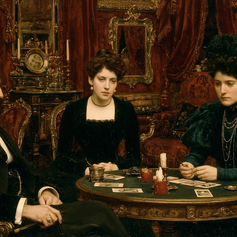
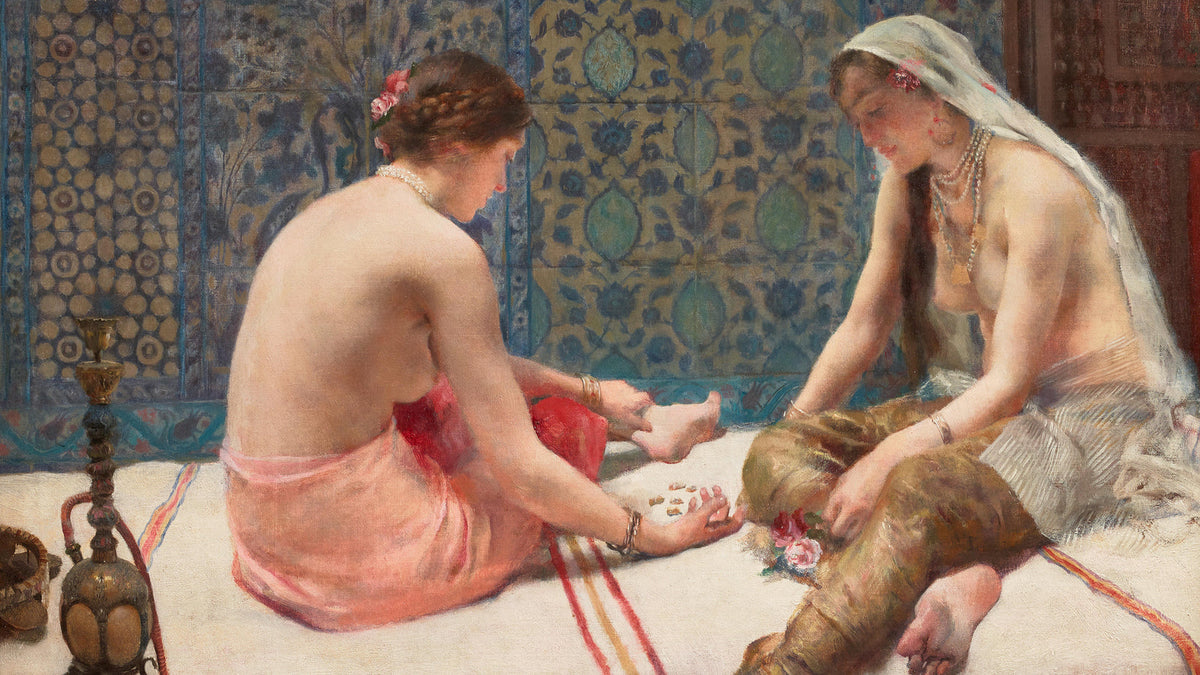
The cover painting, Knucklebone Players by Paul Leroy, dates from the late 19th century. It depicts two women handling knucklebones in an Orientalist setting. Its status should be clear: it is a modern work depicting an ancient game, not a painting discovered on the wall of a Roman villa. It attests to the motif’s continuity in art history. To better situate the very different objects to which societies entrusted their questions, our article Understanding Divination Through the Ages offers a historical extension without conflating the origins of each method.
Chance transformed into the word of the gods
Divination by lot belongs to an ancient family of consultations in which the outcome of a gesture is beyond the voluntary control of the person asking the question. The word cleromancy can refer broadly to this family. Astragalomancy is a particular form of it: the small bone yields values determined by its fall, and these values are linked to an answer. The sacred quality does not reside in the bone by itself. It rests in the whole formed by the consultant, the question, the recognized religious authority, and the words attributed to the gods. Without this context, all that remains is a game or the handling of pieces.
Accounts of Greek divination distinguish several ways of receiving a sign. In some sanctuaries, a recognized person uttered a prophetic statement. In other circumstances, an answer was linked to an object, a draw, or an observed event. These practices did not form a single doctrine applicable throughout the Mediterranean. The best-documented uses of oracular astragals come mainly from cities in southwestern Anatolia under the Roman Empire. It would be excessive to project their rules onto all Greek communities of the Archaic period. The history of astragalomancy is geographically specific, despite the wider fame of the game.
Cambridge University Press has dedicated a study to technical divination in the volume Technologies of the Marvellous in Ancient Greek Religion. It highlights the relationships between chance, numerical conventions, and the making of objects regular enough for their results to be recognized. The religious significance of the throw did not eliminate the need for an intelligible system. A community had to know what result had appeared and how to relate it to an answer. There was therefore technical knowledge surrounding uncertainty, without this amounting to a modern science of probability. The unpredictable nature of the throw was accepted and regulated.
In the oracle inscriptions using astragals, the signs led to messages that had already been engraved. This mechanism differs from a prophecy improvised for each visitor. Chance selected a statement from a public repertoire, interpreted in light of the question. The divine names and formulas associated with certain answers attest to an effort to link the outcome to a legitimate power. The consultant did not discover a number devoid of context: they received a statement that could shed light on a plan, a fear, or a journey. The surviving texts, however, do not make it possible to recover each visitor’s personal reactions.
The knucklebones that were cast did not make all outcomes equally likely, because their faces were neither the same size nor the same shape. Recent studies note that some examples were worked to alter or regularize the chances of how they would land. This observation does not justify accusing those who consulted the oracle of fraud. It reveals one aspect of how it worked: the religious experience also relied on material conventions familiar to its users. The stone that preserved the answers and the bone that produced the combinations belonged to the same apparatus, one durable and the other mobile.
In modern times, methods with very different histories are sometimes grouped under the term magic of chance. The comparison can be useful for reflection, but it must not invent lines of transmission. Geomancy with sixteen figures, for example, also organizes signs, but its attestations, rules, and development belong to other contexts. The Anatolian knucklebones should be understood on the basis of their own inscriptions. A complete system of correspondences cannot be attributed to antiquity simply because it seems coherent to a modern reader.
The power of this divination lies in an idea that is easy to grasp and difficult to exhaust. Someone brings a question they cannot resolve alone; a small event produces a result they did not choose; a recognized tradition gives that event a religious interpretation. In this framework, chance is not merely the opposite of fate. It can become the means through which fate seems to make itself heard. This reading does not imply any proof that the answers foretold future events. It shows how the ancients organized a relationship between human uncertainty and divine speech.
The monuments of Pisidia and the fifty-six answers
Inscriptions discovered in the regions of Pisidia, Pamphylia, Lycia, and southern Phrygia constitute the most compelling evidence of this oracular practice. During the 2nd and 3rd centuries AD, several cities displayed series of responses associated with the casting of astragals. These texts appeared on pillars, bases, and monuments placed in accessible public spaces. They were as much a part of the cities’ religious landscape as of their architecture. Consulting the oracle was not necessarily a private act inside a home. The awaited pronouncement could be read on a stone visible to other inhabitants.
The best-known epigraphic system is based on five astragals and fifty-six possible combinations when the order of the faces is disregarded. This series is understood through the four types of faces on each piece. Predetermined responses corresponded to the possible combinations. The system reveals knowledge of numerical outcomes, but it does not erase the religious significance assigned to each one. Some texts invoke figures such as Apollo or Hermes, whose roles in traditions of oracles and omens are well attested. The names and verses engraved on the stone give the messages their local authority.
At Sagalassos, in Pisidia, archaeologists identified a limestone pillar bearing an inscription of this kind. The stone was found reused in a late fortification near a city gate. Its original location is uncertain, but comparisons with other cities suggest that a monument once stood near the agora. This difference between the place where it was found and the place where it was used is crucial. A block taken from a wall was not necessarily made for that wall. Archaeology traces the different lives of the stone, making it possible to avoid simplistic reconstructions of the ancient religious landscape.
Comparable examples are reported at Termessos and other cities in southwestern Anatolia. Inscriptions could be important enough to form part of the practice of benefactions to the community. A notable who funded a sacred monument thereby demonstrated his place in the city. The inscribed responses were therefore not an isolated curiosity. They took part in social, religious, and urban networks. Their texts, accessible to those who could read them or hear them read, established a shared language for facing uncertainty. The monumental medium gave small repeated throws a stability that an isolated bone could never have possessed.
The study of inscriptions continues to renew our knowledge. A study published in October 2026 in the journal Gephyra examines a new oracular inscription discovered in 2024 in a building in the agora of Kibyra. The authors link it to other monuments used during the imperial period, particularly between 120 and 210 CE. This recent discovery reminds us that the record is not complete. Stones that are still being excavated and reread can change the map of a practice long known only through fragmentary texts. We should therefore avoid presenting astragalomancy as a completely solved mystery.
Even when a monument preserves its formulas, many questions remain. We do not always know who accompanied the consultants, whether a fee was charged, or how much of the answers was explained orally. Some blocks have been moved or recut, and some inscriptions are incomplete. The engraved phrases indicate the answers available, not all the circumstances in which they were consulted. We cannot reconstruct an exact procedure by filling these gaps with assumptions presented as certainties. The historical value of the stone lies in its material reality and its messages, not in the possibility of artificially reinventing a ceremony.
The reuse of monuments in later buildings, in turn, tells a story of religious and urban transformation. Places devoted to seeking answers about fate lost their function, and their materials were used for other structures. The presence of an oracular inscription in a wall does not make the new fortifications sacred: it bears witness to the changed purpose of an old support. The transition from the world of traditional cults to the societies of Late Antiquity is thus visible even in stone. What once carried an answer attributed to the gods becomes a building block that new inhabitants see differently.
Tombs, sanctuaries, and the memory of knucklebones
Archaeological research helps place oracles within a broader material history. The knucklebones found in burials should not all be called divination tools. They may have been connected with childhood games, personal habits, or the desire of loved ones to accompany the dead with objects they knew. The Metropolitan Museum notes the presence of these pieces in tombs. This observation attests to their importance in life and in relationships with the dead, without revealing the exact meaning of each deposit. Caution does not diminish the moving nature of these remains: a small bone can preserve the memory of an entire life.
The same caution is warranted near sanctuaries. Knucklebones may come from games, offerings, or other activities. Their interpretation depends on their precise location, the other objects found with them, and the possible presence of inscriptions. There is indeed a tradition of divination attested by Anatolian stones, but it should not subsume the entire archaeological record. The material history of antiquity requires us to distinguish the object from its use. This approach prevents us from turning every trace of ancient life into a secret practice and recognizes communities’ capacity to play, work, enjoy themselves, and pray at different times.
Images add another dimension to the investigation. The painting by Alexandros of Athens, the figurines at the British Museum, and reliefs depicting players show that astragali circulated across social groups. The figures’ hands, gazes, and anticipation turn the little game into an artistic subject. In some stories, such as the one about Eros in Apollonius of Rhodes, the game can even symbolize fortune’s hold over human beings. The object thus takes on symbolic meaning without leaving the realm of literature. This constant interplay between use, image, and story explains why we need to read the sources rather than impose a single meaning on every depiction.
The knucklebone also offers an instructive contrast with the scholarly instruments of ancient astrology. Celestial calendars, zodiac figures, and planetary hours presuppose a precise system for tracking the movements of the heavens. Divination with astragali uses the earthly event of a fall. These methods could coexist within ancient traditions without belonging to the same system. Our article on the thirty-six decans of astrologers describes another way of linking signs to destiny. Comparing them helps us appreciate the breadth of ancient knowledge rather than erase their historical differences.
Behind the apparent simplicity of the throw lies a social reality. The oracles’ responses were not carved into the wood of a personal toy, but onto stones capable of bringing a collective memory together. These monuments required artisans, inscriptions, places, and people to maintain or consult them. The throw brought an individual situation into a repertoire of words already recognized by a city. A question about the future thus became part of the broader continuity of local traditions. The small movable bone and the fixed stone represent two complementary dimensions of divination: the instant of the sign and the permanence of its language.
Finally, we must make room for what the documents no longer tell us. The names of many people who consulted the oracles are lost; their fears and hopes were not engraved alongside the answers. Historians can describe the materials, inscriptions, and locations of the monuments. They cannot claim to know every emotion an ancient person felt when consulting an oracle, or verify that its outcome really foretold the future. Respecting a religious tradition does not require us to erase these limitations. It also means recognizing the coherence of a system of meaning in which people placed their decisions and expectations.
Thus, knucklebones tell us about more than a forgotten game. They connect homes with sanctuaries, childhood gestures with adults’ questions, and animal bones with inscriptions meant to endure. Through them, Greeks and Romans discovered that the simplest event could be interpreted in several ways. A throw could award a victory, stir an emotion, or deliver a divine message. Understanding astragalomancy does not mean imitating a vanished ancient consultation: it means rediscovering the place chance held in cultures where people might seek the presence of the gods even in a fragment of bone.
Historical and museum sources: Metropolitan Museum of Art, Bronze astragalus and entries for Hellenistic glass astragali; Oxford Classical Dictionary, “Dicing,” 2015; Institute for the Study of the Ancient World, Astragali players, Herculaneum; Cambridge University Press, Technical Divination and Mechanics of Sacred Space; Kileci, Tüner Önen, and Özüdoğru, A New Astragalos Oracle Text from Kibyra, Gephyra, 2026; Salvatore Costanza, Cupido ludens, 2021; Herodotus, Histories, I, 94.
Cover illustration: Paul Leroy (1860–1942), The Knucklebone Players, circa 1899, oil on canvas, private collection, Wikimedia Commons, public domain. This modern scene is not an archaeological depiction of antiquity.

Par Olivier of Aeternum
Passionate about esoteric traditions and the history of the occult from the earliest civilizations to the 18th century, I share articles exploring these subjects. I am also a co-founder of Aeternum, the online esoteric store.