


















































































































































































































In a medieval library, four rows of points traced on a folio may take up less space than a single line of prayer. Yet they open onto a divinatory art of astonishing breadth: sixteen figures, houses borrowed from astrology, Latin names that speak of travel, victory, loss, and encounter, and a system of interpretation transmitted from the Arab world to European scholars. This art bears a name still encountered in occult treatises: geomancy.
Its principle seems almost bewilderingly simple. A figure contains only four rows of points, each row containing one or two. From this economy of signs, geomancers constructed a true language of human circumstances. They used it to ask about the outcome of a journey, the fate of an affair, an opponent's attitude, the prospect of gain, or a relationship. It was not a collection of isolated emblems, but an art of judgment: the same figure could take on a different meaning depending on the question and the position it occupied.
Geomancy deserves particular attention because it brings together two worlds that are wrongly opposed: folk magic, attached to accessible gestures and materials, and the astrological science of medieval scholars. Sand was enough to receive the marks, but reading them required correspondences, distinctions, and a genuine symbolic culture. Centuries before printed divination cards, there was already an oracle made of points, numbers, and houses.
We will trace its historical transmission, understand the nature of the sixteen figures, see how they are entered into a chart, and discover the connections geomancers established with the planets. The aim is not to reproduce a divinatory operation, but to make an ancient tradition intelligible through its structure, vocabulary, and way of conceiving destiny.
From the Sand of Arab Geomancers to European Libraries
The Arabic name for this science, ʿilm al-raml, literally means “science of the sand.” It refers to a highly simple medium: a surface on which marks can be made, counted, and then interpreted. In its catalogue devoted to the medical and occult manuscripts of the Islamic world, the National Library of Medicine notes that geomancy was among the most widespread forms of divination after astrology. This proximity is not incidental. Both arts seek to grasp a situation through an organized language, but they do not require the same instruments.
An astrologer must establish the position of celestial bodies for a particular time and place. The geomancer can work without observing the sky, using figures formed on an earthly surface. However, they borrow the houses, planetary influences, and part of the vocabulary of judgment from astrologers. This material independence partly explains the art's circulation: celestial language is transported into a set of signs that can be produced almost anywhere.
The exact origin of the system of sixteen figures remains difficult to reconstruct. The sources make it possible to trace its use in medieval Arabic-speaking milieus, but they do not justify identifying a certain inventor or a precise date of origin. The historian Thérèse Charmasson points out that the learned geomancy practiced in the Arab world in the 10th and 11th centuries took a mathematical form clearly distinct from ancient conceptions of divination through the earth. In the West, the word geomancy already existed, but its meaning was different.
Ancient classifications placed under this name omens drawn from the ground, such as earthquakes and other terrestrial phenomena. This was not yet the art of the sixteen figures. The arrival of Arabic texts translated into Latin therefore changed the content of an already familiar word. This change in meaning is important: when an ancient author uses geomantia, we cannot automatically assume that they are referring to the figures of dots that European occultism would later preserve.
In the 12th century, several translated texts introduced the method into Latin culture. Thérèse Charmasson identifies, in particular, works associated with Hugh of Santalla and Gerard of Cremona, as well as an anonymous treatise derived from an Arabic transmission. The Spain of the translators, a crossroads of languages and knowledge, played a decisive role here. This movement accompanied the arrival of astrological, medical, mathematical, and philosophical knowledge that would transform European intellectual life.
Nevertheless, it would be reductive to imagine a simple copy of a system fixed once and for all. Names circulate, correspondences shift, Latin commentators reorganize the figures, and distinct reading traditions emerge. Manuscript catalogs reveal several versions of this teaching. Medieval geomancers did not have a definitive edition imposed on everyone, but rather a family of related methods whose rules and interpretations they discussed.
The art also circulated throughout the Islamic world, well beyond the earliest testimonies. The British Library holds, under the shelfmark Or 11313, an Arabic treatise on geomancy transmitted in a 16th-century manuscript and attributed to Naṣīr al-Dīn al-Ṭūsī, a scholar who died in 1274. The description lists sections devoted to the figures, their interpretation, human affairs, and even or odd forms. The attribution of a manuscript is not necessarily proof of the historical author of every passage, but the presence of these subjects attests to the vitality of a written and technical tradition.
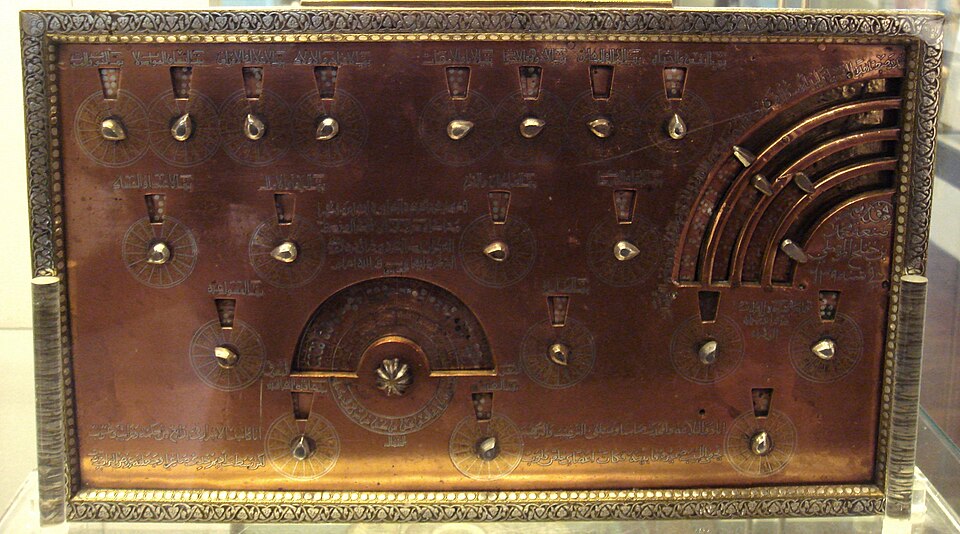
An exceptional piece even makes it possible to give this science a material face. The British Museum holds a geomantic instrument dated 1241–1242, signed by the craftsman Muhammad ibn Khutlukh al-Mawsili. Probably made in Damascus, it combines brass, silver and gold inlays, movable dials, and Arabic inscriptions. It is an object of great sophistication. Its windows reveal combinations of dots, while its inscriptions evoke areas of life and celestial correspondences. The instrument reveals that the art of sand could also become a goldsmith's craft.
The contrast is striking. On one side, a few marks made on a surface of earth; on the other, a metal plate crafted like a scholarly instrument. Their kinship lies in the language of the figures. The British Museum emphasizes that the device mechanically transposes the principles of geomancy and makes it possible to consult areas such as property, family, travel, or the outcome of an undertaking. Geomancy was therefore not confined to the picturesque image of a diviner bent over sand. It could find a place in workshops, courts, and libraries.
The richness of this transmission explains why geomancy fully belongs to the history of divinatory arts. It is not simply an early variant of cartomancy. It represents another way of ordering uncertainty: the signs do not show painted characters, but relationships between positions, forces, and circumstances.
Sixteen figures for naming the movements of fate
Each geomantic figure has four rows, each composed of one or two dots. Four rows, two possibilities for each: there are therefore exactly sixteen combinations, not seventeen or thirty-two. This mathematical closure forms the skeleton of the art. One dot can express the odd and two dots the even; this alternation gives the geomancer their alphabet. In European traditions, the figures are given Latin names. Behind their apparent simplicity lie true portraits of situations.
Via, the Way, designates the path, movement, and passage from one state to another. Each of its four rows contains one point: the figure settles nowhere. It is immediately clear why it may interest a question about travel or transformation. Yet movement is not always a promise. It may announce a welcome departure or harmful instability. Opposite it, Populus, the People, has four rows of two points. It evokes the multitude, the collective environment, the reception of influences, and the strength of the group. The two are traditionally associated with the Moon, but one moves forward while the other gathers.
Puer and Puella, the Boy and the Young Woman, form another ancient contrast. The names are not meant to mechanically assign qualities to people according to their sex. They belong to a symbolic language of action and harmony. In the correspondences widely circulated today, Puer is associated with Mars: impulse, courage, rivalry, initiative that risks becoming rashness. Puella is associated with Venus: conciliation, attraction, propriety, gentleness in relationships. But medieval treatises do not always assign these two figures in the same way. Martin of Spain's work presented at Princeton even shows a tradition in which their planetary attributions differ from the correspondences that have become familiar.
Fortuna Major and Fortuna Minor both bear the name of Fortune, but they do not promise the same form of success. Major Fortune represents a more firmly established force, a foundation capable of lasting, an advantage that withstands the test of time. Minor Fortune evokes a more exposed success, circumstantial assistance, a victory dependent on the moment or on outside support. Their solar kinship must not therefore obscure their difference in stability. Temporary help can be valuable for an immediate objective, while a long-term undertaking calls for another quality.
Acquisitio, Acquisition, opens the register of gain, attainment, and increase. Its favorable reputation does not make it an abstract symbol of wealth: it evokes what comes in, what gathers, or what grows. Amissio, Loss, expresses the opposite movement. Its unfavorable nature is understandable when the question concerns keeping an asset or concluding a deal. But if the issue is getting rid of a burden, ending an attachment, or leaving a burdensome situation, loss can become a release. Geomancy requires precisely this understanding of the question; no figure can be reduced to a label of happiness or misfortune.
Conjunctio means Encounter or Conjunction. It speaks of the bond that forms, a matter that brings people or circumstances together, and the moment when two paths cross. Agreement is not guaranteed merely by the fact of meeting: a conjunction can also introduce a complicated relationship. Carcer, the Prison, evokes confinement, limitation, and what holds back or closes off. In a project that requires momentum, it may announce an obstacle. In a matter where a structure must be maintained, a leak prevented, or a boundary preserved, its fixity takes on another meaning. The nature of a figure remains inseparable from the need against which it is considered.
Albus, the White, belongs to the realm of clarity, moderation, and thoughtful intelligence. European tradition readily links it to Mercury; it suggests speech that explains rather than inflames, more measured judgment, and a mind open to understanding. Rubeus, the Red, responds with intensity: ardor, anger, agitation, and passion that can turn into a rupture. Its customary association with Mars emphasizes the sharp nature of an energy whose consequences must be measured. White and Red are therefore not merely moral colors; they set two states of conduct and discernment against each other.
Laetitia and Tristitia are respectively Joy and Sadness. The former conveys momentum, lightening, a broadening of perspectives, and the feeling that a situation is regaining room to breathe. In several traditions it is associated with Jupiter, the planet of growth and favor. Tristitia, more Saturnian, speaks of weight, gravity, slowing, and what descends or sags. Here again, the name does not dictate an automatic conclusion. Gravity may serve a question of renunciation or closure, while joy is not enough to guarantee the solidity of a commitment.
The last two figures borrow their names from the Celestial Dragon. Caput Draconis, the Dragon's Head, evokes entry, the beginning of a phase, and the opening of a passage. Cauda Draconis, the Dragon's Tail, looks toward departure, dissolution, and the end of a cycle. The connection with the lunar nodes illustrates the dialogue between geomancy and astrology. But an exit is not necessarily a disaster, just as an entrance is not always fortunate. Leaving a danger and entering a bad situation reverse the expected values: the meaning depends on what begins or ends.
These sixteen names together form a particularly concrete language. They include a road and a crowd, an encounter and confinement, a gain and a loss, two fortunes of different duration, two colors, two states of the soul, two figures of youth, and the two extremities of the Dragon. Nothing here resembles a series of interchangeable statements. The vocabulary organizes movements: advancing, receiving, fighting, seducing, gaining, abandoning, assembling, holding back, clarifying, becoming enraged, rising, growing heavier, beginning, and ending.
Finally, one must avoid believing in an immutable table of correspondences. The Latin names and the figures' broad characteristics provide common ground, but the attributions of planets, signs, elements, or favorable qualities vary among authors. Research devoted to Martin of Spain, Bartholomew of Parma, and translators of Arabic origin provides precise examples. Fidelity to tradition means accepting this historical plurality rather than presenting a contemporary framework as a uniform law a thousand years old.
The geomantic chart: a judgment rather than an isolated sign
Geomancy does not stop at recognizing a figure. Its art lies in reading relationships. European manuscripts present, in particular, what is now called a geomantic shield: a structured arrangement in which the figures occupy different functions. The names Mothers, Daughters, Nieces, Witnesses, and Judge recall a family of signs that respond to one another. The four Mothers form the first level; next come four Daughters, four Nieces, then two Witnesses and a Judge. Depending on the school, an additional figure completes or extends the judgment. The exact number of houses and their function can therefore vary across traditions.
This arrangement is not decorative staging. It means that the oracle has several levels of interpretation. An initial figure does not speak in the same register as a witness or a final judgment. The positions express relationships between the elements of the problem. The geomancer does not ask only, “Which figure appeared?” but also, “In what position does it appear, how does it relate to the others, and what question is actually being asked?”
The names of Witnesses and Judge are particularly instructive. They borrow from courtroom vocabulary a way of ordering signs. Several aspects of a case are compared, and then the result is examined in a position of synthesis. This vocabulary should not be read as though the final figure mechanically summarized the entire situation. In the old treatises, qualities, relationships, and exceptions qualify the answer. The structure calls for the reader's discernment.
Another presentation uses geomantic houses, related to the twelve houses of astrology. The areas of life are then distributed within an ordered space: the querent, possessions, relatives, the home, children, illness, partners, death, journeys, authority, hopes, and adversaries. The connection with the sky is not merely visual. It makes it possible to determine what a figure concerns before assessing its nature.
A gain in a house linked to material possessions is not interpreted in the same way as that gain in a house associated with attachment or conflict. A figure of movement takes on a direct significance when travel is involved; it may suggest instability in a matter where one instead wishes to remain. The important thing is not to seek a spectacular meaning in every sign, but to respect the framework of the question. This is where geomancy differs from a catalog of omens consulted out of context.
Our article on astrological houses helps explain the principle behind this distribution. Houses are neither objects nor deities; they are places of interpretation. Geomancy adopted them and then adapted them to an art that does not necessarily require casting a birth chart.
The piece preserved at the British Museum offers an even more instructive presentation. Its dials and Arabic inscriptions arrange sixteen positions, including houses linked to life, possessions, relatives, children, illness, movement, power, hopes, and the outcome of the matter. The device materializes this organization in metal. Its sixteen positions should therefore not automatically be confused with the twelve houses of the Western horoscope or with each version of the Latin shield. It belongs to the same family of arts, but the form of the tables has its own history.
The figures arise from an elementary opposition between even and odd; once established, they are subject to more complex relationships. Arithmetic ensures the coherence of the combinations. Judgment, meanwhile, draws on traditional knowledge about the houses, planets, and meanings. This combination of calculation and symbolic interpretation explains why medieval authors were able to treat geomancy as a technical art rather than mere improvisation.
There is a difference here from card oracles or from the drawing systems presented in our article on tarot. In geomancy, the figures do not represent illustrated scenes; they arise from numerical relationships and occupy defined functions within a chart. Other arts have their own methods and richness, but this economy of points gives geomancy an immediately recognizable character.
The Sky Hidden Behind the Points
It may seem surprising that an art called “the science of sand” speaks so much about the planets. Yet this connection appears at the very heart of medieval transmission. As the figures circulated through Arabic-speaking and then Latin-speaking circles, they engaged with the astrology of the houses, the qualities of the elements, and planetary powers. The earth provides the marks, while the sky contributes to their interpretation. This is not a borrowing added later to lend prestige to a rudimentary custom; it is an important part of learned geomancy as described by medieval sources.
Common systems notably associate Via and Populus with the Moon, Fortuna Major and Fortuna Minor with the Sun, Acquisitio with Jupiter, Puer and Rubeus with Mars, Puella and Amissio with Venus, Albus and Conjunctio with Mercury, and Tristitia and Carcer with Saturn. The two Dragon figures correspond to the language of the lunar nodes. This framework is useful for understanding the kinship between the characters, but it does not replace the study of the schools. A reader of medieval treatises will encounter tables that do not entirely coincide with these associations.
The work of the historian and editor of Martin of Spain's texts, made available online by Princeton, clearly shows this: some correspondences are common, while others vary, particularly for Puer and Puella. The same applies to the zodiac signs and the qualities considered favorable. A modern classification presented without mentioning this history erases the reality of a living transmission, shaped by translations, commentaries, and reorganizations.
The role of the four elements requires the same precision. In several presentations, the rows of points are named Fire, Air, Water, and Earth. This reading helps give the figures a character, according to combinations of active and passive positions. However, elemental interpretations are not all identical from one school to another. Ancient sources also organize the figures by humors, seasons, directions, and degrees of mobility. The element is therefore only one layer of the correspondence.
The relationship between movement and fixity runs throughout the whole system. Via sets the situation in motion; Carcer holds it back. Greater Fortune suggests a more lasting foundation; Lesser Fortune depends more on circumstances. Planetary correspondences give another dimension to these oppositions. Saturn is not merely “bad,” because it also governs duration and consolidation. Mars is not merely a danger, because martial force can defend. A planet describes a mode of action before becoming a moral judgment.
This is also why geomancy should not be confused with a simplified horoscope. It does not calculate the actual position of the Moon and Mercury in the sky at the time of each question. It receives figures to which astral qualities have been attributed. The relationship is analogical and structuring. Traditional astrology nevertheless remains closely connected, as it provides geomancers with an order of correspondences and a grammar of the houses.
Readers already familiar with planetary hour magic will find an analogous principle here: a planet is not a decorative label; it helps situate a quality of the action. The practices are not identical, and calculating the hours does not replace the houses of geomancy, but the same traditional vision connects time, forces, and events.
In the Latin Middle Ages, this kinship with the stars fueled theological and philosophical discussions. Could geomancy belong to the natural arts and produce an acceptable judgment, or did it require the intervention of forbidden spiritual powers? Thomas Aquinas, Roger Bacon, and other thinkers examined the subject, as research on the spread of geomancy in scholarly circles shows. These debates indicate that the art held a sufficiently important place to provoke genuine intellectual objections.
It would be wrong to portray all of Christian Europe as unanimously opposed to geomancy, or all scholars as its defenders. Positions differed according to the nature attributed to the signs, how Providence was understood, the place left for human freedom, and the boundary drawn between natural technique and illicit divination. The tension was real, precisely because the system borrowed from scholarly disciplines while claiming to shed light on affairs yet to come.
An oracle of human affairs spanning the centuries
The questions associated with geomancy did not belong solely to the realm of great royal destinies. The British Museum notice devoted to the 13th-century instrument mentions questions about a child's health, a spouse's fidelity, or the success of a commercial venture. These are ordinary human questions, even when addressed to a complex art. This is one reason for its long presence: geomancy places a learned language within reach of immediate concerns.
In manuscripts, it appears alongside astrology and other interpretive techniques. Latin treatises circulated in the Middle Ages; Persian and Arabic texts continued to be copied; the art later joined the printed compilations of the Renaissance. In the 16th century, the name of Christophe Cattan became associated with its dissemination in France. This long publishing history bears witness to the discipline's persistence, without any need to summarize here the works that transmitted it.
The importance of writing does not erase the existence of a living practice. In manuscripts, diagrams are not ornaments intended to make the page appear strange. They preserve the trace of a method and serve to maintain a common vocabulary. Alongside the texts, a metal instrument may arrange the signs for a consultant. The medium changes, but the demand for interpretation remains. This is a traditional science of interpretation, in the historical sense that authors gave to this term.
Geomancy is not identical either to everything that modern traditions call “geomancy.” Today, the term is used to designate methods for studying places and telluric networks or, by convenient translation, Asian systems of spatial arrangement. The art of the sixteen figures belongs to a specific history, linked to ʿilm al-raml and to Arabic-Latin treatises. To confuse these traditions because they all speak of the earth would be to erase their particular techniques and lineages.
Its value lies, on the contrary, in this clear identity. With four tiers of points, sixteen figures, and ordered positions, geomancy developed a language capable of addressing matters that its readers considered decisive. Its apparent graphic simplicity conceals a rich structure. One must know the figures, recognize the oppositions, understand the question, and place the signs within the framework that gives them meaning.
This explains why the points traced in the sand found their place alongside astrologers and practitioners of other divinatory arts. Geomancy does not replace observation of the sky; it provides access to another way of thinking about correspondences. It does not reduce destiny to a fortunate or unfortunate word; it examines the forms of movement, connection, gain, separation, and duration.
Today, an essential lesson still remains to be learned from this tradition: the figures were never conceived to speak outside the world. Via means something only in the presence of a real path; Carcer takes on its significance when one knows what holds it back; Acquisitio and Amissio require understanding what enters and what leaves a life. Behind a handful of points opens an ancient, structured, and surprisingly precise way of looking at human circumstances.
Sources and references
Thérèse Charmasson, “The First Latin Treatises on Geomancy,” Cahiers de civilisation médiévale, 1978, pp. 121–136: Arabo-Latin transmission, early translators, and the history of the figures and houses.
U.S. National Library of Medicine, Islamic Medical Manuscripts — Astrology, Divination and Magic: the place of ʿilm al-raml in the divinatory sciences of the medieval Islamic world.
British Museum, record for geomantic instrument no. 1888,0526.1, dated 1241–1242 and signed by Muhammad ibn Khutlukh al-Mawsili; presentation of the dials, inscriptions, positions, and uses.
British Library, manuscript Or 11313, ff. 160v–169v, an Arabic treatise attributed to Naṣīr al-Dīn al-Ṭūsī: description of the divisions of the text, the figures, and the preserved tables.
Princeton University, Medieval Geomancy — The Geomantic Figures: correspondences established from the tradition of Martin of Spain, with details on variations among medieval schools.
Wellcome Collection, MS Arabic 664, Treatise on ʿilm al-raml, or geomancy, a preserved and digitized manuscript available to the public.
Emilie Savage-Smith and Marion B. Smith, Islamic Geomancy and a Thirteenth-century Divinatory Device, Undena Publications, 1980, British Museum bibliographic reference.
Documentary illustration: a geomantic instrument in metal inlaid with gold and silver, made in Syria around 1241–1242 by Muhammad ibn Khutlukh al-Mawsili, held at the British Museum. Photograph by PHGCOM, released into the public domain via Wikimedia Commons.

Par Olivier of Aeternum
Passionate about esoteric traditions and the history of the occult from the earliest civilizations to the 18th century, I share articles exploring these subjects. I am also a co-founder of Aeternum, the online esoteric store.













